When buyers first ask me where they should be looking in the Phoenix metro, Arcadia comes up in almost every serious conversation. I’ve worked in this market since 2004, and in all that time I’ve watched Arcadia hold its value, grow its energy, and attract exactly the kind of buyers who want something a little more grounded than a master-planned community but a little more polished than anywhere else close to central Phoenix. Arcadia is, in the simplest terms, the neighborhood that checks every box, and that’s not an accident.
If you’re relocating to the Phoenix area, upgrading from somewhere else in the Valley, or just beginning to understand what makes this stretch of the city so special, this guide covers what I share with every client who asks about Arcadia.
What Makes Arcadia Different
Arcadia sits in a uniquely privileged position on the Phoenix map, tucked between roughly 44th Street and 68th Street, from Camelback Road south to the Arizona Canal, straddling the Phoenix and Scottsdale city limits. That geography matters. You’re close enough to central Phoenix to access the Biltmore corridor, Sky Harbor, and downtown without the slog of a suburban commute, and close enough to Old Town Scottsdale to enjoy its restaurants, galleries, and nightlife whenever you want. But Arcadia itself is quieter, leafier, and more residential than either of those areas.
What I always tell buyers is that Arcadia has a particular sense of permanence. The tree canopy that shades its streets is decades old. The homes sit on generous lots. The neighbors tend to stay for years. There is an irrigation system that feeds the landscape, a legacy of the agricultural era that shaped this part of the Valley, and it gives Arcadia a greenery you don’t often find in the desert Southwest. When you stand on a block near the canal on a winter morning, it genuinely feels like a different world than the rest of Phoenix.
Arcadia suits buyers who want a connected, walkable neighborhood with a genuine sense of community and the kind of mature landscape that simply cannot be built from scratch.
The Arcadia Lifestyle: Dining, the Canal, and Being Outside
Arcadia’s dining and social scene has expanded considerably in recent years, and it has done so in a way that feels true to the neighborhood’s character. The restaurants and cafes here tend to be independently owned. You won’t find many national chains; instead you’ll find places like O.H.S.O. (Outrageous Homebrewer’s Social Outpost) along the Arizona Canal, which has become a neighborhood gathering point for morning coffee and weekend afternoons alike. Minnow, opened in 2025 by Chef Bernie Kantak, brought a matcha cafe and sushi counter that quickly became a local favorite. The Porch at 1916 E Camelback Road offers Southern-influenced comfort food with a sprawling outdoor patio that captures everything Arcadia is about: relaxed, welcoming, and a little bit special.
The Arizona Canal path is a genuine daily-use amenity here. The canal trail network extends more than 80 miles across the Valley, but Arcadia’s stretch is particularly well maintained, with lighting, landscaping, and public art installations. Residents use it to walk to coffee, bike to the farmers market, or simply get outside without getting in a car. For a city that is often described as car-dependent, this walkability is a genuine differentiator, and something buyers consistently tell me they underestimated before they moved here.
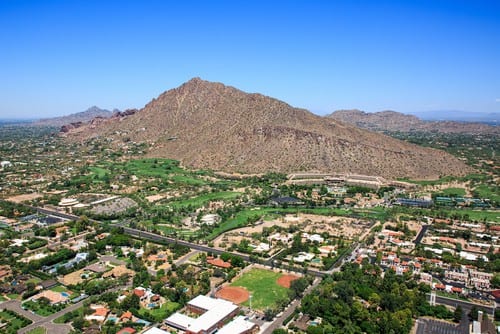
Camelback Mountain anchors the neighborhood’s northern edge and offers some of the best hiking in Arizona right outside your front door. The Echo Canyon and Cholla trailheads draw residents year-round, though the most committed locals learn quickly to be on the trail before 7 a.m. in summer.
For buyers who want culture, dining, and outdoor recreation within walking distance of their front door, Arcadia delivers in a way almost nothing else in the Valley can match.
Real Estate in Arcadia: What to Expect in 2026
Arcadia is not an affordable neighborhood, and it was never meant to be. Median sale prices in 2026 are hovering around $1.5 million, reflecting a 2 to 3 percent year-over-year increase that has been consistent with the neighborhood’s historical pattern of steady appreciation rather than volatile swings. What that price buys you varies considerably depending on where in Arcadia you’re looking.
Arcadia Proper, the original and most established sub-section, runs roughly from 44th Street east to about 68th Street and features the largest lot sizes, often from a quarter acre to more than half an acre, with some legacy lots approaching an acre. Here you’ll find a mix of meticulously renovated mid-century ranch homes, Spanish Mediterranean estates, and contemporary rebuilds that maximize the indoor-outdoor living that Arizona’s climate makes possible. These homes command a premium and tend to attract buyers who appreciate architectural integrity alongside modern amenities.
Arcadia Lite is a more accessible entry point, generally referring to properties closer to 44th Street and Indian School Road, with smaller lots and more infill product. If you’re stretching to get into the Arcadia zip code but aren’t ready for Arcadia Proper prices, this is where I’d suggest starting your search.
If you’re considering Scottsdale as an alternative, Arcadia often competes favorably on price per square foot when you account for lot size and proximity to central amenities. The Biltmore corridor is also worth considering if you want a similar walkable, established feel, though Arcadia has the edge on greenery and the canal trail.
Schools in Arcadia
School assignment in Arcadia depends entirely on your specific address, and this is one of the first things I walk buyers through before they fall in love with a particular property. Most Arcadia addresses fall within Scottsdale Unified School District, one of the highest-performing districts in Arizona, though some western portions of the neighborhood feed into Phoenix Union or Madison districts.
Within SUSD, many Arcadia students attend Arcadia High School, which offers honors coursework, Advanced Placement programs, dual enrollment options, and Career and Technical Education through EVIT. At the elementary level, Hopi Elementary and Tavan Elementary are the names that come up most often among buyers with younger children. Echo Canyon School serves kindergarten through eighth grade and has a strong community following. Before you make an offer, I always recommend confirming the attendance boundary with the district directly, as SUSD’s district-open enrollment policy can also give families some flexibility.
Frequently Asked Questions About Living in Arcadia, Phoenix
What is the average home price in Arcadia, Phoenix in 2026?
Median sale prices in Arcadia in 2026 are approximately $1.5 million, up 2 to 3 percent from the prior year. Arcadia Proper, where lots are larger and homes are more architecturally significant, tends to run higher, while Arcadia Lite offers entry points more commonly in the $900,000 to $1.2 million range depending on size and finishes.
What school district covers Arcadia, Phoenix?
Most Arcadia addresses fall within Scottsdale Unified School District (SUSD). Key schools include Arcadia High School for grades 9 through 12, Hopi Elementary, Tavan Elementary, and Echo Canyon School for kindergarten through eighth grade. School assignment is address-specific, so always verify with the district before purchasing.
Is Arcadia, Phoenix walkable?
For Phoenix, Arcadia is remarkably walkable, particularly along the Camelback Road corridor and near the Arizona Canal trail. You can walk or bike to restaurants, coffee shops, and the canal path from most addresses. A car is still useful for larger errands and commuting to areas beyond the immediate neighborhood.
What is the difference between Arcadia and Arcadia Lite?
Arcadia Proper refers to the original, more established section of the neighborhood with larger lots, commonly a quarter acre to more than half an acre, and higher price points. Arcadia Lite is an informal term for properties closer to 44th Street and Indian School Road, which tend to feature smaller lots and a wider range of product types, including townhomes and infill builds, at more accessible price points typically starting below $1 million.
What restaurants are in Arcadia, Phoenix?
Arcadia’s dining scene includes O.H.S.O. along the Arizona Canal, Minnow (a matcha cafe and sushi concept from Chef Bernie Kantak, opened in 2025), The Porch at 1916 E Camelback Road, and Salt + Lime Modern Mexican Grill, among many independently owned cafes and boutiques. The neighborhood has very few national chains, which gives it a distinctly local character that residents value.
How does Arcadia compare to Scottsdale or Paradise Valley?
Arcadia offers a more urban-adjacent feel than Scottsdale, with closer proximity to central Phoenix and a more walkable, established neighborhood character. Compared to Paradise Valley, Arcadia tends to have smaller lot sizes and lower price points, but more neighborhood energy and street life. Buyers who want seclusion and estate-sized lots often choose Paradise Valley; buyers who want a connected, community-oriented neighborhood with great dining nearby often land in Arcadia.
If you’re curious about what it would actually look like to live in Arcadia, I’d love to show you. I’ve worked this neighborhood for years and know which blocks, which streets, and which properties represent the best opportunities right now. Reach out here and let’s start the conversation.